
Dr. Munir Ahmad

Dr. Munir Ahmad
Chairman
HEC Approved Supervisor
Phone: +92-51- 9292137
Email: [email protected]

Dr. Muhammad Tariq
Associate Professor
HEC Approved Supervisor
Phone: +92-51-9292137
Email: [email protected]

Dr. Asim Gulzar
Associate Professor
HEC Approved Supervisor
Phone: +92-51-9292130
Email: [email protected]

Dr. Muhammad Asif Aziz
Associate Professor
HEC Approved Supervisor
Phone: +92-51-9062288
Email: [email protected]

Dr. Farid Asif Shaheen
Associate Professor
HEC Approved Supervisor
Phone: +92-51-9292137
Email: [email protected]

Dr. Imran Bodlah
Assistant Professor
HEC Approved Supervisor
Phone: +92-51-9290013
Email: [email protected]
Bio-Systematics Laboratory Laboratory
Welcome to the Bio-Systematics Laboratory of the Department of Entomology, which is mainly collection-based and focuses on the systematics in the broadest sense, including basic taxonomy, phylogenetic studies, comparative morphology, biodiversity, population biology and ecology. In addition, Scientists normally focus their research towards insect groups of economic importance in Agriculture.
Facilities
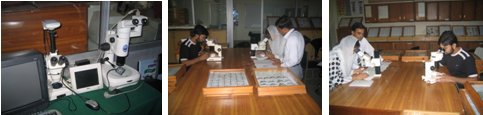
Biosystematics Laboratory is equipped with simple identification microscopes (12), Labomed microscopes (8) with the facility of digital microscopy, Nikon trinocular microscope with digital camera and digital LCD for microscopy (1), Leica trinocular microscopes with digital camera (2), Noif binocular microscope (7) Olympus dissection microscope (3) and Swift binocular microscope (2).
Interested Research Areas
Work by members of the lab have involved several groups of insects identified including Damselflies (1061 specimens collected, 51 species), Dragonfly (1349 specimens collected, 68 species) Ants (300 specimens collected, 22 species), Mantids (200 specimens collected, 31 species), Cranfly (197 specimens collected, 9 species), Aphids (3000 specimens collected, 30 species), Aphid parasitoids (10827 specimens collected, 26 species), Aphid hyperparasitoids (1257 specimens collected, 6 species) Long horned beetle (300 specimens collected, 9 species) Potter wasps (151 specimens collected, 3 species), dung beetles (350 specimens collected, 12 species) and Cetoniid beetle (400 specimens collected, 9 species). Laboratory still maintains un-explored collection of hundreds of insects belonging to various insect orders. Trophic associations of various aphid parasitoids species have been the main areas of interest. Aphid parasitoid and hyper-parasitoids identifications were also confirmed by using various biological parameters like mummy coloration and position of emergence hole.
Currently students are involved in exploring the Coleopterous and Lepidopterous fauna of Punjab Province of Pakistan.
Insect Toxicology Laboratory
Monitoring of insecticide resistance to conventional and new chemistry insecticides is underway for important insect pests like leaf worm, Spodoptera litura and diamond backmoth, Plutella xylostella as test organisms. Studies include toxicity effects on biological and life history parameters.
Facilities
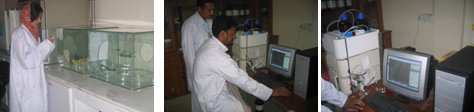
The laboratory is equipped with instruments for insecticide testing like topical and residual testing of insecticides not only on insects but also for food materials using high performance liquid chromatography. Test insects are standardized under controlled rearing room for these testing studies.
Interested Areas of Research
Our laboratory interests include insecticide resistance monitoring and involvement of resistance mechanisms especially esterases, interested for new toxic components in test materials like botanicals against test insects and their residuals effects on them.
Stored Product Entomology Laboratory
In the Stored Product Entomology Laboratory, the research is focused on different aspects of insect pests management. Especially studies regarding identification and biology, insect control with the use of different types of insecticides and control of insects through controlled atmosphere are being carried out.
Facilities
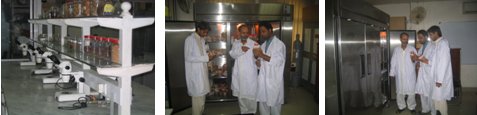
The lab is well equipped with highly sophisticated incubators, automatic micro applicators, heavy duty sieve shaker, stereo zoom microscopes, digital moisture meters, phoshphine meters, chemical sifters, different mill units along with other accessories to be used in taxonomic, bio-ecological and management of stored grain insect pests.
Interested Research Areas
The research is being conducted on:- Taxonomic and bio-ecological studies on different stored grain insect pests.
- Quality of stored grains in relation to insect pests damage Residual studies of different insecticides and botanicals on stored grain insect pests.
- Stored grain´s insect pest management using controlled atmosphere.
- Rearing of different stored grain insect pests to assess post harvest losses.
- Evaluation of different commercially available insecticides for insect pest management.
Insect Bio-control & Integrated Pest Management Laboratory
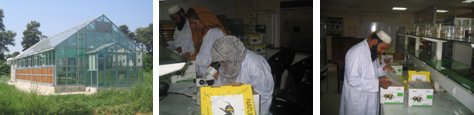
To utilize and encourage the beneficial organisms like predators, parasitoids and parasites to fight insect pests is a powerful and economical part of Integrated Pests Management. Bio-control and IPM Laboratory is located in the Department of Entomology, PMAS-Arid Agriculture University, Rawalpindi. This Lab provides facilities for rearing pest and bio-control agents and evaluating their effectively. The laboratory also assists in conducting research and devises strategies to develop IPM strategies of major insect pests of agricultural crops. This laboratory is also strengthened with recently established glasshouse along with rearing rooms facility. To foster use of bio-control agents in the management of major pests this laboratory has been developed with the support of Higher Education Commission Pakistan. This would be a unique facility in the country where researchers will develop methods for propagating, storing and actively using beneficial organisms.
Facilities
Bio-control and IPM laboratory is equipped with the rearing faculties for insects. Fully equipped Growth Chambers to conduct experiments under controlled environmental conditions and insect rearing cabin housing the insect rearing stands and cages are made available for research work. A glasshouse along with 2 rearing rooms is also recently added to this laboratory. The laboratories also have facility to preparer artificial diet for the rearing insects. Various incubators, ovens, insect collection kits, glass and plastic cages of various sizes, glassware and chemicals etc are available for experimentation. A small identification and preservation arrangement for the insect pests and their natural enemies is also maintained at the laboratory.
Interested Research Areas
The on-going research areas are given as below: Sorghum shoot fly and its egg and larval parasitoids, a field study of barani (rain-fed) areas. Functional response of coccinellid beetles and Green lace wings against rose aphids is underway. A research project on potential of bio-control agents of Plutella xylostella and their interaction with the host plants is going to be initiated. Studies related to Tri-trophic relationships of the hosts, host plants and the bio-control agents are also being planned to manage various insect pests.
Apiculture
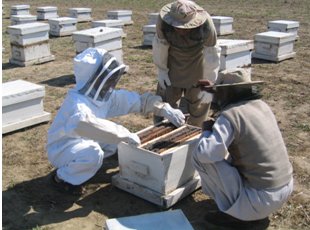
Honey bees, the marvelous insects used to produce honey and enhance pollination in various crops. They are practical models of biological organization and social behavior. The Apiculture section working under Department is located at University Research Farm Chakwal road. Apiary was established at the farm on Jan. 05, 2011. Around 76 colonies of bees forage on various crops, fruit trees, ornamentals, flowers, weeds and grasses etc. Apiary is well equipped with beekeeping requirements such as honey extractors, ripeners, queen excluders, wax foundation machine, smokers, and protective clothing.
Education Extension
Students for undergraduate and postgraduate studies are provided basic and applied education in Apiculture. The extension program is designed to give practical training to farmers and beekeepers. This will be impacted in developing beekeeping culture in the country and will enhance the honey production.Research focus
The research focus of Apiculture section is to further our understanding of honey bee biology and to develop our ability of bee management. To accomplish these goals, we are involved in various experiments that incorporate technical and applied aspects of beekeeping. This program serves the needs of the university and general public by proving extension services and instruction built on basic and applied research.
Research Projects
