
Women development studies center

Syeda Iram Umer
Incharge
Email: [email protected]
Entrepreneurship in Education What, Why, When, How
Message of the Director
Every Woman has the opportunity to earn a dignified livelihood. The establishment of this Women Development Studies Center (WDSC) is to increase opportunities for income generation among Women of Pothwar Plateau, by strengthening their skills, business capacities and market linkages, thereby facilitating them in accessing better economic opportunities and improving their quality of their life and that of their families. There is a dire need, to support the step of young university female graduates as an “entrepreneur” in to job creation and market.
Being one of the leading members of my team, I am confident that WDSC enables our students to become “entrepreneurial” in order to seek more self-creating job opportunities through the strong market linkages.
About WDSC
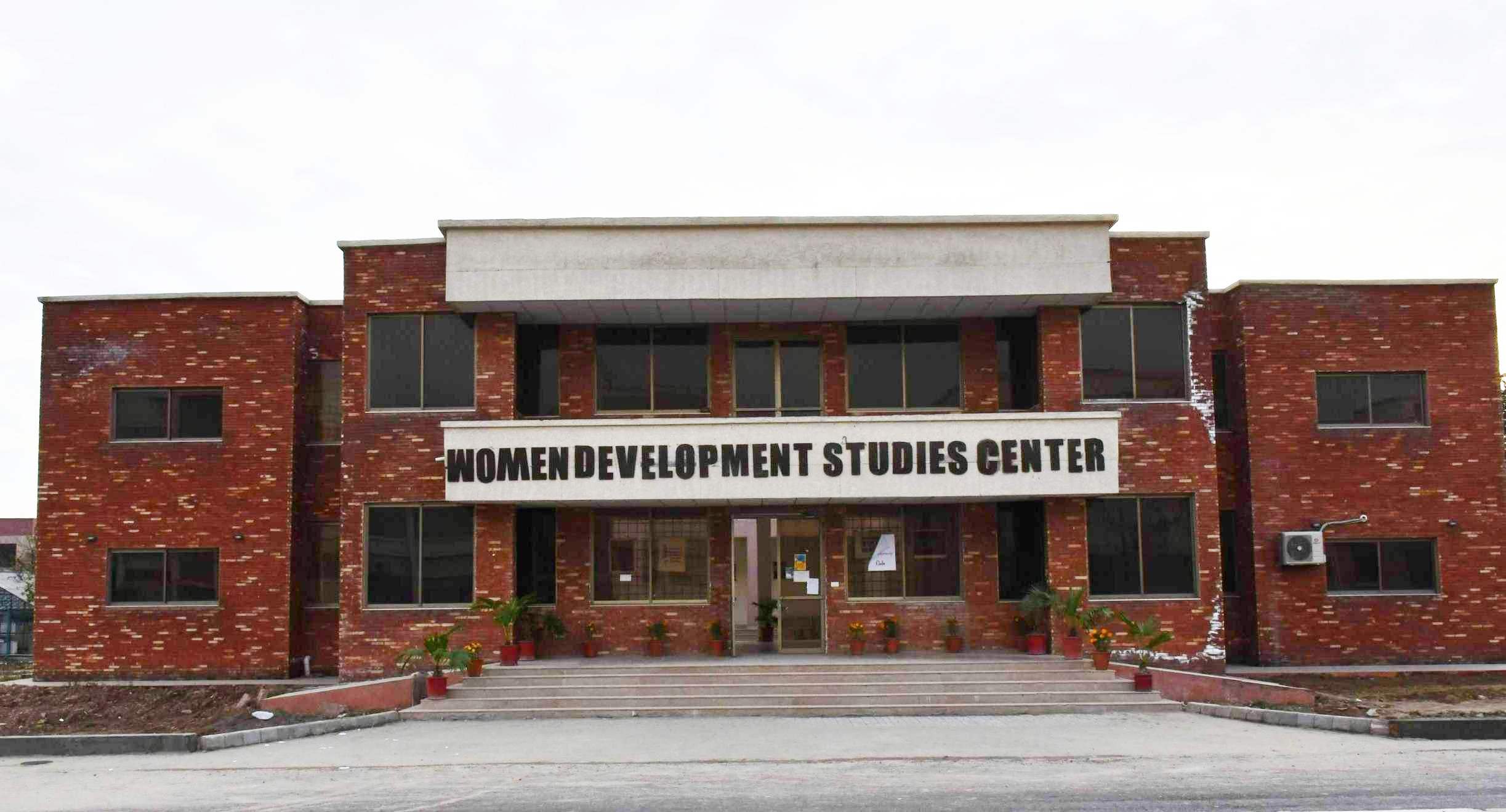
The Women Development Studies Center (WDSC) was established in 2016. The establishment of this center in one of the pioneer effort is being made in the Rawalpindi or Pothwar region. This is the first formal step to strengthen the bond between education & entrepreneurship. Keeping in view the skills and ability of self generating income activities of the Pothwar women, this center aims at empowering the existing women’s business skills and as well as equipping with desired entrepreneurial market-based skills to the womenfolk. This center will prove a milestone in identifying skillful and vocational women (educated & uneducated) in order to recognize their true role in the economic development of Pakistan.
Our Vision
Empowering Women through Entrepreneurship Education.
Our Mission
To empower Women of Pothwar region through business incubation initiatives.
Entrepreneurship in Education
WHAT
Entrepreneurship is when you act upon opportunities and ideas and transform them into value for others. Through Entrepreneurship education, we focus more on the specific context of setting up a venture and enabling university graduates self-employed. Our Mission regarding Entrepreneurship is about personal development, creativity, self-reliance, initiative taking and action orientation. It is not only limited to the entrepreneurial university graduates, but also to entrepreneurial opportunities and the relation between the individual and the opportunity. WDSC develop three Entrepreneurial competencies of university graduates such as Knowledge about how to get things done without resources, Risk and probability models. Basics of entrepreneurship, value creation, idea generation, opportunities, accounting, finance, technology, marketing, risk, etc.
Secondly Skills for conducting market research, Assessing the marketplace, Marketing products and services, Persuasion, Getting people excited about your ideas, dealing with customers, communicating a vision. Leadership, Motivating others, Managing people, Listening, Resolving conflict, Socializing Active learning, Adapting to new situations, coping with uncertainty Setting priorities (goal setting) and focusing on goals, Defining a vision, Developing a strategy, Identifying strategic partners.
Thirdly develop attitudes: “I want.” Need for achievement. “I can”. Belief in one’s ability to perform certain tasks successfully. “I am / I value”. Deep beliefs, Role identity, Values. “I do”. Action-oriented, Initiator, Proactive. “I dare”. Comfortable with uncertainty and ambiguity, Adaptable, Open to surprises. “I create”. Novel thoughts / actions, Unpredictable, Radical change, Innovative, Visionary, Creative, Rule breaker. “I overcome”. Ability to overcome adverse circumstances. These three competencies affect the willingness and ability of university graduates to perform the entrepreneurial job of new value creation and play in the economic prosperity of the country. This is at the core of entrepreneurship and is also a competence that all university students increasingly need to have in order to cope with the challenges of today’s society.
WHY
Why entrepreneurship is relevant to education has so far primarily been viewed from economic points of view. The most common reason behind WDSC mission to promote entrepreneurial education is that entrepreneurship is seen as a major engine for economic growth and job creation. Entrepreneurial education is also frequently seen as a response to the increasingly globalized, uncertain and complex world we live in and Sustainable development Goals (SDG’s) requiring all individuals and organizations in society to be increasingly equipped with entrepreneurial competencies. Besides the common economic development and job creation related reasons to promote entrepreneurial education, there is also a less common but increasing emphasis on the effects entrepreneurial activities can have on students’ as well as employees’ perceived relevancy, engagement and motivation in both education and in work life. Finally, the role entrepreneurship can play in taking on important societal challenge has positioned entrepreneurial education as a means to empowering university graduates and organizations to create social value for the public good.
WHEN
In the future we can hope for a greater awareness of the need to develop and establish progression models for entrepreneurial education, rather than continuing the quest for a ”one size fits all” approach to entrepreneurial education. In the future teachers will hopefully have access to classifications, frameworks and other support material allowing them to pick and choose from a large variety of pedagogical tools and methods allowing them to more quickly identify and hone a teaching style and progression strategy appropriate to their own students, contexts and available resources. The future will hopefully also bring a consciousness that any age is the right age for introducing assignments where students use their competencies to create innovative value to people outside university. Earlier is of course better since it allows for better progression, but it is never too late to start. Such a start will hopefully also more often consist in embedded value creation for all students rather than separate venture creation for a few interested students.
HOW
There is a need of advice for university teachers, on what to let students do in order to develop their entrepreneurial competencies. In the future we can hope for increased understanding of why learning-by-doing works and how it can be integrated into education. Teachers should give their students assignments to create value (preferably innovative) to external stakeholders based on problems and/or opportunities the students identify through an iterative process they own themselves and take full responsibility for. Such assignments lead to repeated interactions with the outside world, which triggers uncertainty, ambiguity and confusion. This should be regarded as a positive outcome and a source of deep learning. To alleviate the levels of difficulty and uncertainty such an assignment can result in, a team-work approach should be applied giving the students access to increased creative ability and peer learning opportunities. Sufficient time allowing for establishing fruitful relationships with external stakeholders should also be given to the students, preferably months or years. If so, it will have happened through a concerted effort involving teachers, students, policymakers, researchers, authorities, international associations and other key stakeholders, all playing their important role in the substantial challenge of succeeding in educational reform. In the future we will hopefully also see the strengthening of explicit support structures in all the departments of university as well as other crucial management and organizational structures, supporting teachers and students in the task of interacting with the outside world leading to tandem learning and value creation.
Quaid’s Messages
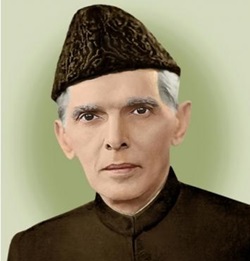
The great personality and founder of Islamic republic of Pakistan, Quaid-e- Azam Mohammad Ali Jinnah said:
“Another very important matter which I want to impress upon you, is that no nation can rise to the height of glory, unless women are side by side with you. We are victims of evil customs. It is a crime against humanity to shut up women within the four walls of houses as prisoners. Let us try to raise the status of women according to Islamic ideals and standards. There is no sanction anywhere for the deplorable conditions in which our women have to live. We should take the women along with us as comrades in every sphere of life. We cannot expect a women who is ignorant herself to bring up our children properly. Women have the power to bring up children on the right lines. Let us not through away this asset”.
“It is women alone who can teach men how and when to wield the sword or pen when the occasion arises. You, young women, are fortunate than your mothers are. You are being emancipated. I do not mean that you must copy the west. But I do mean that man must be made to understand that a women is his equal and that women is his friend and comrade and they together can build up homes, families and nations”.
The words coincides beautifully with the mission statement of Madina: “We will establish a state in which a young maiden laden with jewelry and ornaments will travel alone from San’aa in Yemen to Busra in Syria (a distance of more than 1500 miles), yet, she will have no fear but the fear of ALLAH..”News & Events
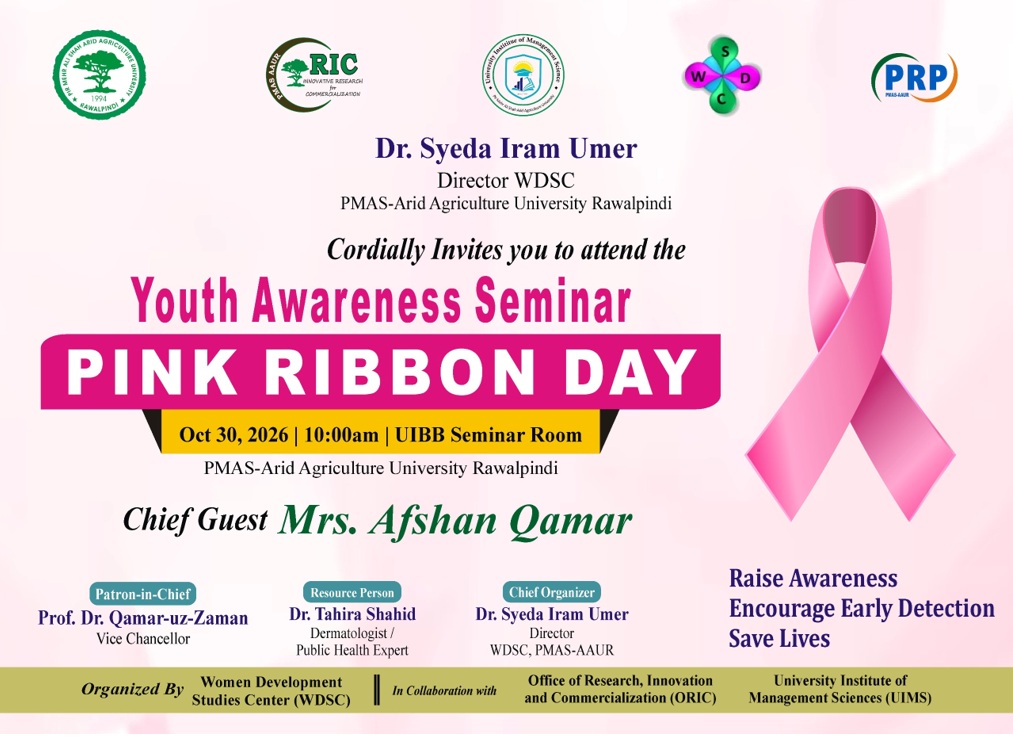
Youth Awareness Seminar – Pink Ribbon Day (30 October 2026 | 10:00 AM | UIBB Seminar Room)
- Introduction and Event Overview
The Women Development Studies Centre (WDSC), in collaboration with the University Institute of Management Sciences (UIMS) and the Office of Research, Innovation and Commercialization (ORIC), PMAS-Arid Agriculture University Rawalpindi, organized a Youth Awareness Seminar on Pink Ribbon Day on 30 October 2026 at the UIBB Seminar Room. ORIC supported the event financially and served as a collaborating partner. The seminar was organized to promote breast cancer awareness among students and the university community, encourage informed health-seeking behaviour, and highlight the importance of timely medical guidance and support for those affected by breast cancer.
- Opening Ceremony and Welcome
The programme commenced with the recitation of the Holy Quran, setting a respectful and thoughtful tone for the gathering. The participants and distinguished guests were then welcomed, including the Honourable Chief Guest, Mrs. Afshan Qamar, and other guests, faculty members, doctors and students. The welcome remarks highlighted that breast cancer awareness is not merely a medical concern but a shared responsibility that calls for education, timely medical guidance, open discussion and a supportive environment.
- Awareness Talk by the Resource Person
Dr. Tahira Shahid, Dermatologist and Public Health Expert, delivered an informative and engaging awareness talk. Drawing on her professional experience in public health and community awareness, she emphasized the importance of understanding breast health, recognizing possible warning signs and seeking professional medical advice without delay. She encouraged participants not to ignore unusual changes in the breast, such as a new lump or thickening, changes in breast shape or size, skin dimpling or changes around the nipple, and to consult a qualified healthcare professional if they notice anything unusual.
Dr. Tahira also stressed that awareness and early medical assessment can make an important difference. She encouraged women to become familiar with what is normal for their own bodies, overcome hesitation or stigma around discussing breast health, and seek guidance from qualified health professionals. The session reinforced that awareness activities should promote informed consultation and should not replace professional diagnosis or individual medical advice.
- Closing Remarks
Following the awareness session, Dr. Syeda Iram Umer, Director of the Women Development Studies Centre (WDSC), delivered the closing remarks. She acknowledged the importance of collective efforts in advancing women’s health and well-being and appreciated the resource person, chief guest, collaborating partners, university leadership, faculty members, organizers and students for contributing to the seminar. She reiterated the value of continuing awareness initiatives that encourage women to prioritize their health and support one another.
- Acknowledgement and Presentation of Souvenirs
As a gesture of appreciation, the university acknowledged the distinguished guests and resource person for their presence, contributions and support. Souvenirs were presented to Mrs. Afshan Qamar, Honourable Chief Guest, and Dr. Tahira Shahid, Resource Person, on behalf of the university by Prof. Dr. Qamar-uz-Zaman, Vice Chancellor, PMAS-AAUR. The contributions of the other guests, including Madam Bushra Aqeel, were also appreciated.
- Visit to Awareness Stalls
After the formal proceedings, the distinguished guests visited the awareness stalls arranged as part of the event. They took an interest in the displays and activities and appreciated the efforts made to communicate health-related information and promote awareness. The stall visit provided an opportunity to extend the seminar’s message beyond the formal session and encourage interaction around the importance of breast health.
- Organizing and Collaborating Teams
The event was jointly managed by Dr. Anum Shafique on behalf of UIMS and Dr. Syeda Iram Umer on behalf of WDSC. Dr. Farida Faisal, Director UIMS, provided institutional leadership from the UIMS side. The programme was organized by WDSC in collaboration with UIMS and ORIC, with ORIC providing financial support. The university’s collaborative approach helped bring together academic, administrative and awareness-focused efforts for a cause of significant public importance.
- Conclusion
The Pink Ribbon Day Youth Awareness Seminar served as a meaningful platform for promoting breast cancer awareness, encouraging open conversations about breast health and emphasizing the importance of timely consultation with qualified healthcare professionals. The participation of the distinguished guests, the informative contribution of the resource person, the closing message from WDSC, and the awareness stalls collectively strengthened the purpose of the event. The organizers extend their gratitude to the Vice Chancellor, the Chief Guest, the resource person, all guests, ORIC, UIMS, WDSC, faculty members, students and everyone who contributed to making the event possible.
Downloads
- Teacher Remuneration Form
- Panal of Foreign Experts for Thesis Examinaiton (Ph.D)
- Panel of Local Experts / External Examiners for Ph.D Thesis Examinations
- Panel of Experts for Thesis Examinations of M.Sc (Hons)/M.Phil
- Thesis Evaluation Performa for all Postgraduate Programmes (Except Ph.D.)
- Application For Verification Of Documents
- Payment of Remuneration For Master Thesis to Major Supervisor/Co-Supervisor & External Examiner
- Application Form for Provisional Certificate
- Application Form for (DMC) Official Transcript of Record
- Application Form for Degree / Diploma
- Application Form for Degree Clearance
- Application Form for Intermediate (Pre-Agriculture) Certificate